

.jpg "Birds Name Guide: Discover Amazing Species and Their Habitats")
.jpg&description=Explore a detailed guide to birds name, covering common species, habitats, features, behavior, food, and fascinating facts about birds found around the world.)
Birds are among the most recognizable and diverse animals on Earth. They can be found in almost every environment, from busy cities and agricultural fields to dense forests, wetlands, mountains, deserts, and coastal regions. Their feathers, wings, beaks, songs, and remarkable ability to adapt have made them an important part of natural ecosystems and human culture. Learning the birds name of different species is also a simple way to begin understanding biodiversity and the natural world.
There are thousands of bird species across the planet, and each has its own combination of physical characteristics, behavior, habitat preferences, and feeding patterns. Some birds are tiny enough to fit comfortably in a person’s hand, while others have enormous wingspans. Some spend most of their lives in trees, whereas others are specialized for swimming, hunting, running, or living near human settlements.
For students, nature enthusiasts, travelers, and anyone interested in wildlife, knowing different birds name can make everyday observations much more meaningful. A bird seen on a balcony, near a pond, or during a walk may belong to a species with fascinating adaptations that are easy to overlook.
Understanding the Diversity of Birds
Birds belong to the class Aves and share several characteristics that distinguish them from other groups of animals. Feathers are their most recognizable feature, while wings, beaks, lightweight skeletons, and specialized respiratory systems help many species survive in different environments. Although not every bird is capable of sustained flight, flight remains one of the defining adaptations associated with modern birds.
The enormous variety among birds is reflected in their body shapes and lifestyles. Birds of prey typically possess strong feet and curved beaks suited to catching or tearing food. Waterbirds often have adaptations that help them swim or feed around wetlands. Seed-eating birds may have short, strong bills, while nectar-feeding species frequently have specialized beaks and tongues. These differences demonstrate how birds have evolved in response to their surroundings and available food sources.
Common Birds Found Around People
Many bird species live close to humans because towns and cities provide food, nesting opportunities, water, and shelter. Sparrows, pigeons, crows, mynas, bulbuls, doves, and several types of parakeets are familiar examples in many parts of the world. Their presence can make urban environments more biologically diverse.
Some common birds become so familiar that people rarely stop to observe them closely. Yet their behavior can reveal interesting details. A crow may demonstrate impressive problem-solving abilities, while a sparrow can build an intricate nest using surprisingly small pieces of natural and human-made material. Watching familiar birds carefully is often the easiest starting point for learning identification.
A Useful Birds Name List
The following table provides examples of recognizable bird species and some of their broad characteristics. Common names can vary between countries and regions, so scientific identification may sometimes be necessary for greater accuracy.
| Bird | General Habitat | Typical Food | Notable Feature |
|---|---|---|---|
| Sparrow | Cities, villages, farmland | Seeds and insects | Adaptable urban bird |
| Peacock | Forest edges, grasslands | Plants, insects, grains | Elaborate display feathers |
| Eagle | Mountains, forests, open land | Fish and animals | Powerful talons and eyesight |
| Parrot | Forests and tropical regions | Fruits, seeds, nuts | Strong curved beak |
| Owl | Forests, farmland, cities | Small animals | Excellent low-light hunting |
| Flamingo | Wetlands and shallow lakes | Algae and small organisms | Long legs and curved bill |
| Kingfisher | Rivers, ponds, wetlands | Fish and aquatic prey | Specialized fishing ability |
| Penguin | Coastal and polar regions | Fish and marine animals | Flightless swimming specialist |
| Peacock | Woodland and open habitats | Seeds, plants, insects | Male’s ornamental train |
| Hummingbird | Gardens and forests | Nectar and tiny insects | Extremely rapid wing movement |
How Birds Are Classified
Bird classification involves more than simply grouping birds according to appearance. Scientists consider physical structures, behavior, genetics, evolutionary relationships, and other characteristics when determining how species are related. Modern classification systems continue to develop as researchers obtain new genetic and ecological information.
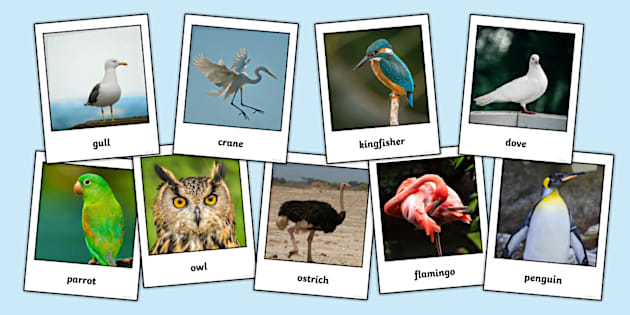
For everyday birdwatching, however, a simpler approach is often more useful. Observers can begin with size, body shape, colors, beak structure, habitat, flight pattern, and vocalizations. These clues can help distinguish similar-looking species. For example, two small brown birds might appear almost identical at first, but their calls, tail movement, habitat, or feeding behavior may provide useful identification clues.
Birds of Prey
Birds of prey are specialized hunters that generally possess strong feet, sharp talons, and hooked beaks. Eagles, hawks, falcons, and some owls are familiar examples. Their eyesight and physical strength allow them to locate and capture prey efficiently.
Different predators have developed different hunting strategies. Falcons may pursue prey through fast aerial movement, while some eagles rely on soaring and powerful dives. Owls are particularly associated with nighttime hunting and possess adaptations that help them detect prey in low-light conditions. These birds also play an ecological role by helping regulate populations of other animals.
Waterbirds and Wetland Species
Wetlands support a remarkable variety of birds because they provide food, water, nesting locations, and shelter. Ducks, herons, kingfishers, storks, cranes, and flamingos are among the species associated with aquatic environments. Some feed in shallow water, while others search through mud, vegetation, or deeper areas.
Wetland birds are especially interesting because their bodies often reflect their feeding strategies. Long-legged species can move through shallow water without completely submerging their bodies, while birds with broad bills may filter or collect food from water. Protecting wetlands therefore benefits not only birds but also many other species that depend on these ecosystems.
How to Identify Different Birds
Learning bird identification does not require advanced equipment. Careful observation is often more important than expensive tools. Start by considering the bird’s approximate size and shape. Next, look at its colors, markings, wing pattern, tail shape, and beak. Its surroundings can also provide an important clue because certain species are strongly associated with particular habitats.
Behavior is another useful identification feature. Notice whether the bird walks, hops, climbs tree trunks, swims, dives, hovers, or spends most of its time in flight. Listening to its call can also help. With practice, birdwatchers begin recognizing species from sounds even before seeing them clearly.
A practical observation routine can include these steps:
- Observe the bird without disturbing it.
- Note its size, colors, beak, wings, and tail.
- Record the habitat and location where it was seen.
- Pay attention to movement and vocalizations.
- Compare several characteristics rather than relying on one feature.
What Do Birds Eat?
Bird diets vary enormously depending on species, habitat, body structure, and seasonal availability. Some birds primarily eat seeds and grains, while others specialize in insects, fish, nectar, fruits, small mammals, or carrion. Many species are opportunistic and change their diets according to what is available.
Food preferences are closely connected to beak shape. A strong, thick bill can help crack seeds, whereas a long or pointed bill may be better suited to catching insects or extracting nectar. Birds that hunt fish may have sharp bills designed for gripping slippery prey. These adaptations demonstrate the close relationship between anatomy and survival.
In urban areas, birds sometimes consume human-provided food, but this does not mean every type of food is suitable for them. Natural foods and species-appropriate feeding practices are generally more appropriate than giving birds heavily processed or unsuitable foods.
Bird Habitats and Their Importance
A bird’s habitat provides more than a place to live. It supplies food, nesting areas, protection from predators, and opportunities for reproduction. Forest birds depend on trees and understory vegetation, grassland species may require open areas, and wetland birds depend on aquatic ecosystems.
Habitat changes can therefore have significant effects on bird populations. Urban expansion, agricultural changes, pollution, removal of vegetation, and alteration of wetlands can reduce suitable areas for some species. At the same time, gardens, parks, restored wetlands, and protected forests can create valuable spaces where birds can feed and reproduce.
Birds and Seasonal Movement
Migration is one of the most fascinating aspects of bird behavior. Some birds travel enormous distances between breeding and non-breeding areas, often following seasonal patterns linked to food availability and weather conditions. Other species remain in the same region throughout the year but may move locally when conditions change.
Migratory birds depend on suitable habitats along their journeys. A wetland that appears small on a map can be extremely important if it provides food and rest for birds traveling between distant locations. This is one reason why conservation efforts often need to consider entire migration routes rather than isolated breeding sites.
The Role of Birds in Ecosystems
Birds perform many ecological functions. Fruit-eating species can spread seeds, allowing plants to colonize new areas. Insect-eating birds help control insect populations, while nectar-feeding birds can contribute to pollination. Scavenging birds help remove organic remains from ecosystems, supporting natural nutrient cycles.
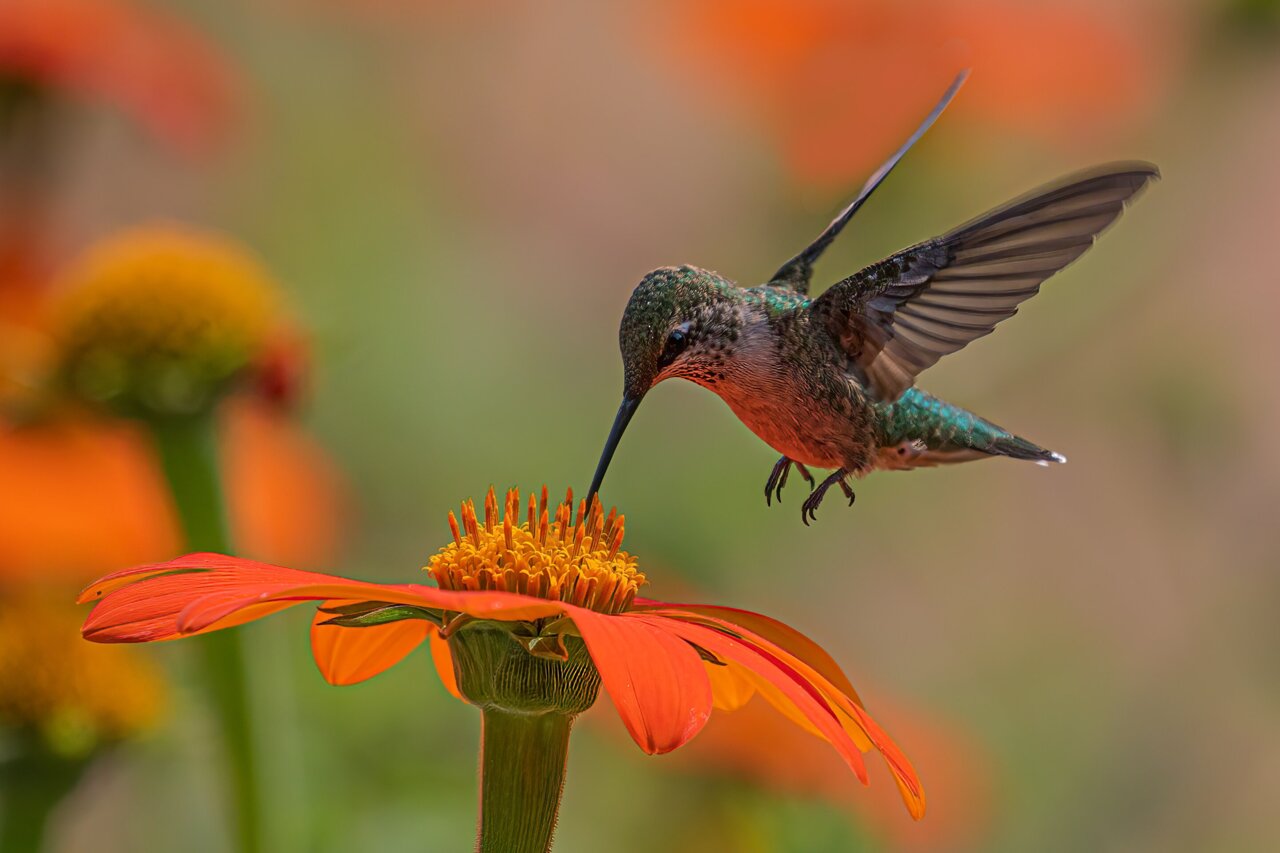
Because birds occupy many different ecological niches, changes in their populations can provide useful information about environmental conditions. A decline in particular species may indicate habitat loss, food shortages, pollution, or other ecological pressures. Bird observation is therefore not simply a recreational activity; it can also contribute to broader understanding of environmental change.
Birds in Cities and Modern Environments
Urban environments are not necessarily bird-free spaces. Parks, gardens, balconies, trees, rooftops, water bodies, and even building structures can provide opportunities for birds to survive. Some highly adaptable species have become successful urban residents because they can use a wide range of food and nesting resources.
However, city life can also create challenges. Traffic, glass buildings, noise, artificial lighting, domestic animals, pollution, and reduced vegetation can affect birds. Simple changes such as maintaining native plants, protecting mature trees, providing suitable natural shelter, and reducing unnecessary disturbance can make urban spaces more supportive of birdlife.
Why Learning Bird Names Matters
Learning the birds name of species is more than memorizing a list of vocabulary. Correct identification creates a stronger connection between people and their surroundings. Once someone can distinguish a sparrow from a finch or a hawk from a kite, ordinary outdoor experiences become opportunities for observation and learning.
For children, bird identification can introduce concepts from biology, ecology, geography, and environmental science in an engaging way. For adults, it can become a relaxing outdoor hobby. Even a few minutes spent watching birds from a window or during a walk can reveal patterns in feeding, communication, nesting, and movement.
Technology has also made bird observation more accessible. Smartphones can be used to record photographs and sounds, while digital identification tools can help beginners compare observations with known species. These tools are most useful when treated as aids rather than replacements for careful observation.
Simple Ways to Support Local Birds
People can make their surroundings more welcoming to birds without creating artificial dependence. Native vegetation can provide natural food and shelter, while clean water sources can be valuable during hot or dry periods. Protecting nesting areas and avoiding unnecessary disturbance during breeding periods can also help.
A bird-friendly environment does not have to be large. Even a balcony with suitable plants or a small garden can provide resources for insects and birds. The goal should be to create conditions that support natural behavior rather than simply attracting as many birds as possible.
Fascinating Facts About Birds
Birds display an extraordinary range of abilities. Some species can navigate over long distances, while others can remember complex locations associated with food. Certain birds use tools, solve problems, imitate sounds, cooperate with other individuals, or demonstrate sophisticated courtship behavior.
Flight itself also varies greatly. Some birds glide for long periods with minimal wing movement, while others can hover, dive, or perform rapid aerial maneuvers. Penguins demonstrate another remarkable adaptation: although they cannot fly through the air, their wings have evolved into highly effective flippers for underwater movement.
The variety found among birds makes any general statement about them incomplete. A tiny nectar-feeding bird and a large soaring raptor may look completely different, yet both demonstrate adaptations shaped by their environments over long periods of evolution.
Conclusion
Understanding the birds name of different species provides a useful introduction to the extraordinary diversity of the natural world. From familiar urban sparrows and pigeons to powerful eagles, colorful parrots, specialized kingfishers, and long-distance migrants, birds occupy an impressive range of ecological roles and habitats. Birds are important not only because of their beauty and fascinating behavior but also because they contribute to healthy ecosystems through seed dispersal, pollination, insect control, predation, and nutrient cycling. Learning to identify them encourages people to observe nature more carefully and recognize the environmental conditions that support wildlife.