



Love has always been one of the most fascinating parts of human life. Whether someone has a crush on a classmate, is beginning a new relationship, or simply wants to discover what their name might reveal about a romantic connection, curiosity about love is natural. In the digital age, online entertainment tools have made it easier than ever to explore these feelings in a playful way. One popular example is the love calculator name, a simple concept that uses the names of two people to generate a compatibility score or percentage.
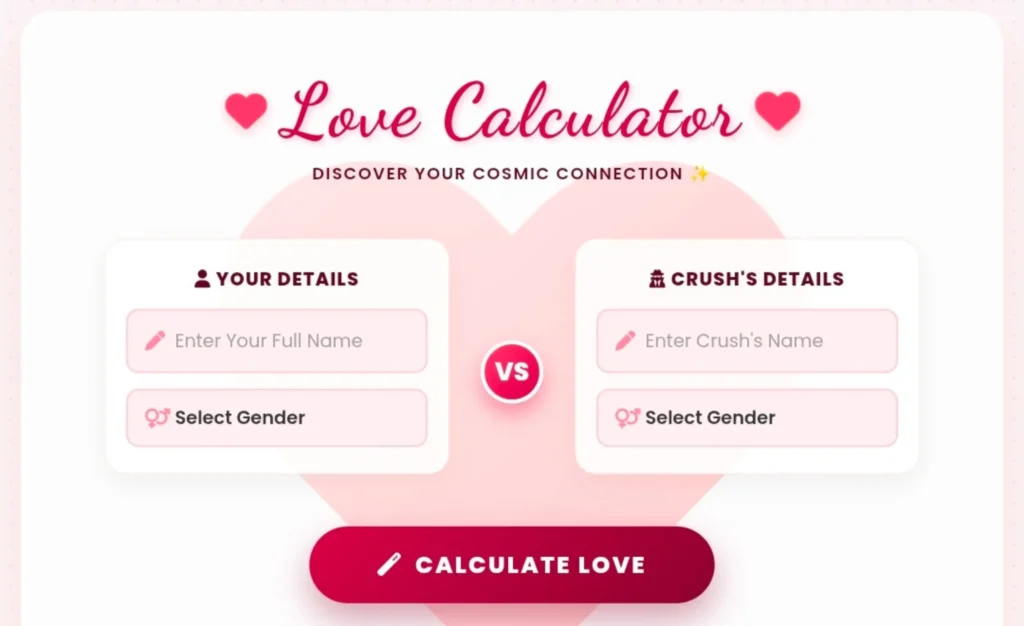
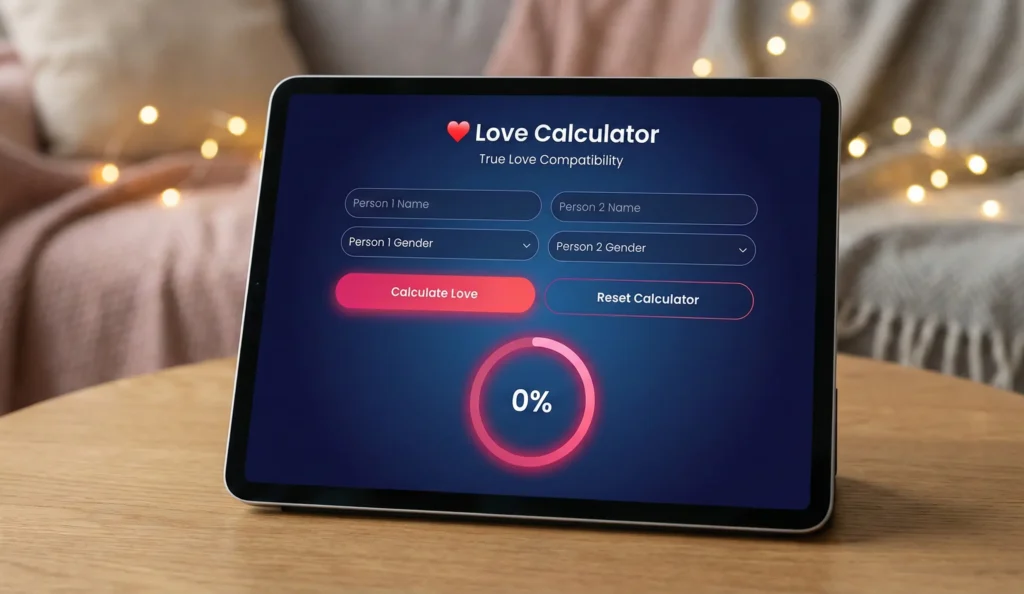
The idea behind this tool is straightforward. A person enters their name and the name of someone they like, and the calculator produces a result that represents their supposed romantic connection. Some versions display a percentage, while others include a short message about attraction, friendship, or potential compatibility. The result can be entertaining, especially when shared with friends or a romantic partner. However, it is important to understand that these calculations are designed primarily for amusement rather than scientific relationship assessment.
As people increasingly use digital platforms for entertainment, name-based compatibility games continue to attract attention because they are simple, accessible, and easy to understand. They offer a lighthearted way to start conversations about relationships without requiring personal information about someone’s feelings or behavior. Understanding how these tools work, what their results mean, and where their limitations lie can help users enjoy the experience without confusing an entertaining prediction with genuine romantic compatibility.
What Is a Love Calculator Name Tool?
A name-based love calculator is an entertainment tool that estimates romantic compatibility by processing the names of two individuals. Users generally enter their own names along with the name of a person they admire, and the calculator generates a result. Depending on the design, this result might be expressed as a percentage, a compatibility category, or a short description of the connection between the two people.
For example, someone named Rahul might enter his name alongside Priya’s name. The calculator could return a compatibility score of 82 percent and describe the match as promising. Another calculator might produce a different result for exactly the same names because its calculation method differs. This variation highlights an important point: the result is generated by the tool’s programming rather than by a reliable measurement of the individuals’ feelings, personalities, or future together.
These calculators are popular partly because they require very little effort. Unlike detailed personality assessments or relationship questionnaires, most name-based tools need only two names to produce a result. The quick response creates an element of surprise, making the activity suitable for casual entertainment, social gatherings, and playful conversations between friends.
How Does a Love Calculator Name Work?
The process behind a name-based calculator depends on how its developer has designed the tool. Some calculators assign numerical values to letters, combine those values, and apply a mathematical formula to generate a percentage. Others use predetermined rules, character counts, letter patterns, or randomly generated results. Although the final output may look precise, the percentage does not automatically represent a meaningful assessment of romantic compatibility.
Consider a calculator that converts each letter into a number, adds the values together, and uses the total to produce a score. Another calculator might compare the number of letters shared by two names. Both methods can generate a result, but neither establishes whether two people communicate effectively, respect one another, or share similar relationship expectations. The calculation is simply a programmed process that transforms text into an entertaining output.
A typical experience involves three basic steps:
- Enter your name in the first field.
- Enter the other person’s name in the second field.
- Select the calculate option and read the generated result.
Some tools also offer compatibility descriptions, playful suggestions, or options to calculate another match. The exact features vary, so users should understand that there is no universal formula followed by every calculator.
Why Are Name-Based Love Calculators So Popular?
One major reason for their popularity is simplicity. People are naturally curious about romantic possibilities, and a name-based game offers an immediate result without requiring a long questionnaire or complicated instructions. A person can test a match in seconds and move on with their day. The low-effort format makes the activity appealing to teenagers, young adults, couples, and anyone who enjoys casual relationship-themed entertainment.
Another reason is the social element. Friends may compare results, tease one another about crushes, or challenge a partner to calculate their compatibility. A surprisingly high percentage can become a conversation starter, while a low score can create a humorous moment. In these situations, the entertainment comes less from the number itself and more from the reactions and conversations it encourages.
Digital culture also contributes to the appeal. Short quizzes, personality games, and interactive calculators are easy to share in group chats and social media conversations. Name-based compatibility games fit naturally into this environment because the results are simple to understand and can be discussed without extensive background information. Their popularity does not necessarily mean that users believe every prediction; many people participate simply because the activity is fun.
What Does Your Love Compatibility Percentage Mean?
The percentage displayed by a calculator is best understood as a game result rather than an objective measurement. A score of 95 percent may look impressive, but it does not prove that two people are destined to be together. Likewise, a score of 30 percent does not indicate that a relationship will fail. Without a scientifically validated method, the number cannot reliably predict attraction, commitment, or long-term relationship success.
The following table explains how different results might be interpreted for entertainment purposes. These categories are illustrative examples rather than official standards used by every calculator.
| Example score | Playful interpretation | Practical meaning |
|---|---|---|
| 90–100% | A seemingly perfect match | Enjoy the result without treating it as proof |
| 70–89% | A promising connection | Real compatibility still depends on both people |
| 40–69% | A possible match | A number cannot establish romantic potential |
| 0–39% | An unexpected result | A low score does not determine relationship outcomes |
Imagine two people who receive a score of 45 percent but communicate openly, support each other’s goals, and resolve disagreements respectfully. Their relationship could be much healthier than that of two people who receive a score of 99 percent but struggle with trust and communication. Real relationships depend on behaviors and choices that a simple name-based calculation cannot evaluate.
It is therefore helpful to treat every percentage as a fictional score generated for entertainment. Users can enjoy a favorable result without developing unrealistic expectations, and they can laugh at an unfavorable one without feeling discouraged about a genuine connection.
Love Calculator Name and Real Relationship Compatibility
Real compatibility is more complex than comparing names. It develops through communication, mutual respect, emotional understanding, shared expectations, and the willingness to work through disagreements. Two people do not need identical personalities or interests to build a healthy relationship, but they generally benefit from understanding one another and respecting their differences.
Communication is particularly important because it allows partners to express their needs, discuss uncomfortable topics, and clarify misunderstandings. Someone who listens carefully and responds honestly can contribute to a stronger connection than someone who simply shares a name pattern that produces a high calculator score. Trust also develops through consistent actions, such as keeping promises, respecting boundaries, and being dependable when difficulties arise.
Shared values can influence long-term compatibility as well. People may have different hobbies but similar expectations regarding family, finances, personal independence, or future plans. Understanding these differences often provides more useful insight than any entertainment-based percentage. A calculator can start a conversation about attraction, but getting to know the other person is what helps reveal whether a meaningful relationship is possible.
Different Ways to Enjoy a Name Compatibility Calculator
A name-based calculator can be used in several lighthearted situations. Someone with a crush might enter two names out of curiosity, while a couple might use the result as part of a playful date-night activity. Friends can also compare scores for fictional characters, celebrity pairings, or imaginary couples from their favorite stories, provided the activity remains respectful and does not encourage intrusive speculation about real people’s private relationships.
The tool can also provide an opportunity to reflect on what attraction means to the individual using it. After receiving a result, a person might ask themselves what they appreciate about the other individual, whether they feel comfortable communicating with them, and what kind of relationship they hope to build. These questions can be much more meaningful than the score because they focus on genuine feelings and personal expectations.
For example, suppose someone receives a high score for a person they barely know. Instead of assuming that a relationship is guaranteed, they could use the result as a humorous reason to start a friendly conversation, if appropriate. If the other person is not interested, their boundaries should be respected. The calculator should never be treated as evidence that someone secretly likes the user or owes them romantic attention.
Important Limitations of Name-Based Love Predictions
The biggest limitation is the absence of reliable scientific evidence that names alone can predict romantic success. Names may have personal, cultural, or emotional significance, but a basic letter-based formula does not measure the qualities that usually shape a relationship. A numerical result can appear authoritative even when it is generated using an arbitrary rule.
Another limitation is that different calculators can produce different percentages for the same pair of names. One may use a fixed mathematical formula, another may use letter comparisons, and a third may produce randomized results. Without a validated method, there is no reason to assume that one result is more accurate than another. The apparent precision of a percentage should not be confused with genuine predictive ability.
Users should also avoid making important emotional decisions based on these results. Ending a promising relationship because of a low score, pursuing someone because of a high score, or assuming that two people are meant to be together can lead to unnecessary confusion. Relationships should be evaluated through real interactions, mutual interest, and consistent behavior rather than through entertainment-based predictions.
Privacy and Responsible Use of Online Calculators
Although many name calculators ask for only two names, users should still pay attention to privacy. Some websites may include advertising, analytics, or other data collection practices. Before entering information, it is sensible to consider whether the tool requires anything beyond basic text and whether its privacy practices are clear.
For a simple entertainment activity, users generally do not need to provide sensitive information such as phone numbers, home addresses, passwords, private photographs, or personal account details. A calculator that requests unnecessary personal information deserves additional caution. If the activity is being used with friends, it is also courteous to avoid entering another person’s details into a service without considering their privacy.
Responsible use means remembering that the activity should remain enjoyable and harmless. A compatibility result should not be used to embarrass someone, pressure them into a relationship, or make claims about their private feelings. Keeping the experience playful helps ensure that a simple game does not become a source of emotional discomfort.
How to Make the Most of a Love Compatibility Result
The best way to enjoy a name-based result is to approach it with curiosity rather than expectation. A high score can be a fun surprise, and a low score can be an opportunity for a joke. Neither outcome should change how a person treats someone else or determine whether a relationship deserves a chance.
People who want to explore a genuine connection can use the experience as a starting point for more meaningful reflection. They can consider whether conversations feel natural, whether both people show interest, and whether each person respects the other’s time and boundaries. These observations provide practical insight that a numerical formula cannot supply.
It can also be useful to separate fantasy from reality. Having a crush often involves imagination, excitement, and uncertainty, especially when two people have not spent much time together. A calculator may add to the excitement, but it cannot confirm that the other person shares those feelings. Real understanding develops gradually through communication and experience, and it requires willingness from both sides.
Conclusion
A love calculator name tool offers a simple and entertaining way to explore the idea of romantic compatibility. By entering two names, users can receive a percentage or a playful description that makes them curious about a potential match. Its simplicity, quick results, and social appeal explain why this type of digital activity remains enjoyable for people who like quizzes and relationship games.
However, the results should always be understood in the right context. Names and mathematical formulas cannot establish whether two people are emotionally compatible, genuinely attracted to one another, or likely to build a lasting relationship. Those qualities become clearer through honest communication, mutual respect, trust, shared values, and consistent actions over time.
Ultimately, the greatest value of a name-based love calculator lies in the entertainment it provides, not in its ability to predict the future. Enjoy the percentage, share a laugh with friends, and use the experience as a playful conversation starter. When it comes to real love, the connection two people build together matters far more than any number generated on a screen.