


Love has always been one of the most fascinating parts of human life. From the excitement of a first crush to the happiness of finding someone special, romantic feelings can make everyday experiences feel extraordinary. People often look for different ways to understand their emotions, explore their compatibility with a partner, or simply have fun with a friend. One popular online entertainment concept is the love calculator name, which uses the names of two people to generate a playful compatibility score. It offers a lighthearted way to explore romantic curiosity without requiring complicated questions or personal information.
The idea behind name-based love calculations is simple. A person enters their name and the name of someone they like, and the calculator produces a percentage or a short compatibility message. Some versions use letter combinations, basic number patterns, or randomly generated results to make the experience entertaining. Although these results can be exciting, they should not be treated as scientific evidence of attraction or a reliable prediction of a relationship’s future. Real love depends on many factors, including trust, communication, respect, emotional understanding, and shared values.
Understanding how these calculators work can make the experience more enjoyable. Rather than relying on a number to decide whether two people belong together, users can treat the result as a conversation starter or a fun activity. Learning about their purpose, common calculation methods, benefits, and limitations also helps people maintain realistic expectations while enjoying a popular form of digital entertainment.
What Is a Love Calculator Name?
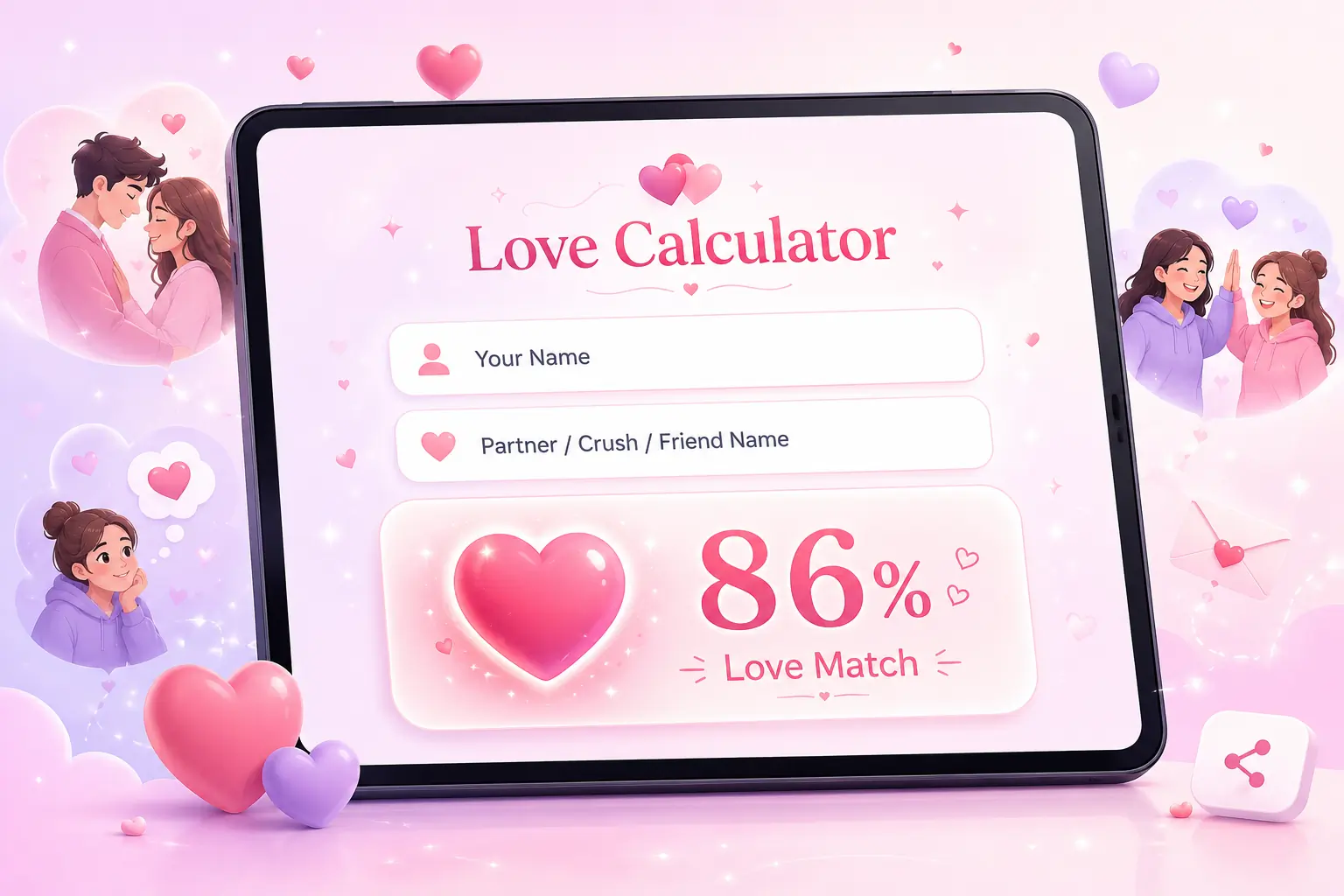
A love calculator name is an entertainment tool designed to estimate romantic compatibility using the names of two individuals. Users usually enter their own name and the name of a crush, partner, or person they admire. After submitting the names, the calculator displays a score, often expressed as a percentage, along with a short interpretation of the result. For example, a result of 85% might be described as a promising romantic match, while a lower score might suggest that the pair should get to know each other better. These descriptions are generally intended to entertain rather than provide meaningful relationship assessments.
The popularity of this concept comes from its simplicity and emotional appeal. People are naturally curious about relationships, especially when they have feelings for someone but are uncertain about how those feelings might develop. A name-based result gives them something easy to discuss with friends or share during a casual conversation. Couples may also use it as a playful activity during a date or on a special occasion. However, the result depends on the particular calculator’s design, not on a verified measurement of emotional compatibility. Two different tools can produce different scores for exactly the same names.
How Does a Love Calculator Name Work?
Most name-based calculators follow a straightforward process. The user enters two names, the system processes the text, and a result appears on the screen. The underlying method varies from one tool to another. Some calculators use letter positions, repeated characters, or simple mathematical formulas. Others combine names into a numerical pattern before converting that pattern into a percentage. Certain entertainment tools may generate results using predefined rules that are designed primarily to make the experience engaging. Without knowing the exact method used by a particular calculator, it is impossible to determine precisely how its score was produced.
Consider a fictional example involving two people named Aisha and Rahul. A calculator might assign numerical values to the letters in both names, combine those values, and convert the final number into a percentage. Another calculator might use a different formula and display a completely different result. Neither result establishes whether Aisha and Rahul are emotionally compatible. Their relationship would depend on how they communicate, whether they trust each other, and how they respond to challenges. The calculation is simply a playful interpretation of the names entered into the system.
Common Methods Used for Name Compatibility
Different calculators can use different approaches to create their results. Some methods are mathematical, while others are based on entertainment conventions. Common approaches include the following:
-
Letter-based calculations that assign numerical values to individual characters.
-
Name-combination formulas that process the spelling of both names.
-
Numerology-inspired patterns that associate numbers with symbolic meanings.
-
Randomized results designed to provide a surprising or entertaining percentage.
These approaches may look different, but they share an important limitation: they do not scientifically establish whether two people will develop a successful romantic relationship. Their primary purpose is to provide amusement and encourage curiosity.
Why Are Name-Based Love Calculators So Popular?
One major reason for their popularity is that they require very little effort. Users do not need to complete a long questionnaire, understand complicated instructions, or explain personal relationship experiences. Entering two names is often enough to generate an immediate result. This simplicity makes the activity accessible to people who want a quick moment of entertainment. It can be particularly appealing to teenagers and young adults who are experiencing crushes, although adults may enjoy it as well. The short format also makes it suitable for casual conversations, social gatherings, and lighthearted online activities.
Another reason is the emotional curiosity associated with romance. When someone likes another person, even a small suggestion about compatibility can feel exciting. A high score might create a moment of happiness, while an unexpected result might encourage laughter or friendly debate. The experience can become more interesting when people compare results using different name combinations. Nevertheless, it is important to recognize that an entertaining result does not reveal another person’s feelings. Someone receiving a high percentage should not assume that the other person is interested in them, and a low percentage should not be interpreted as a warning against a potentially healthy relationship.
Understanding Love Compatibility Scores
A compatibility percentage is one of the most recognizable features of these tools. Many calculators present their results using a scale from 0% to 100%, making the outcome easy to understand at a glance. A higher number is commonly associated with a stronger fictional match, while a lower number may be presented as a less promising combination. Some calculators add short descriptions, such as excellent chemistry, growing attraction, or a need for better understanding. These labels make the result feel personalized, even when the calculation is based only on names.
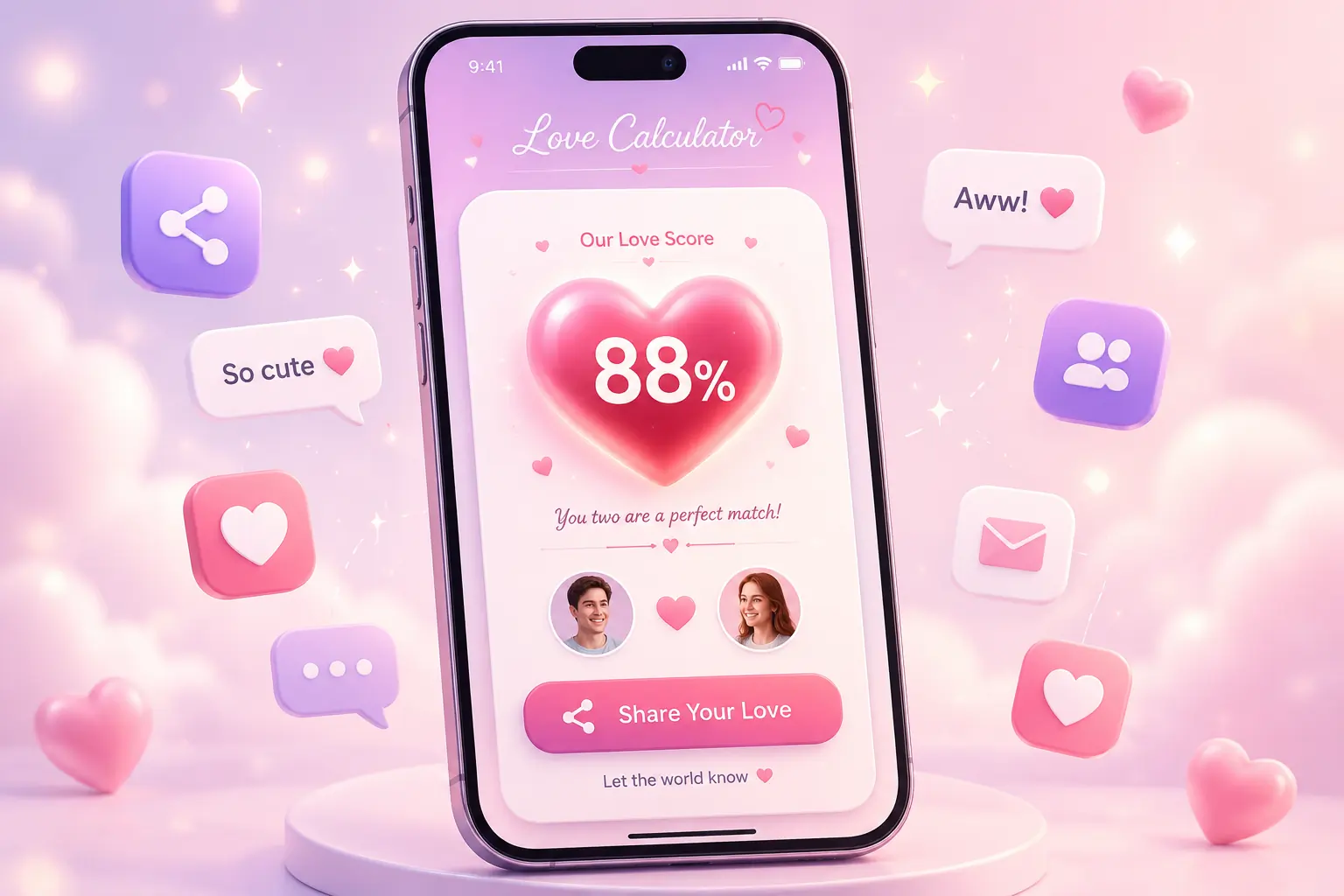
However, percentages should not be confused with measurable relationship probabilities. A score of 92% does not mean there is a 92% chance that two people will fall in love, marry, or remain together. Likewise, a score of 24% does not mean that a relationship is destined to fail. There is no universally accepted scientific formula that converts two names into an accurate prediction of romantic success. The score is meaningful only within the entertainment experience provided by that particular calculator.
| Compatibility score | Common entertainment interpretation | Practical perspective |
|---|---|---|
| 90–100% | An exciting or excellent match | Enjoy the result, but learn about each other naturally. |
| 70–89% | A promising romantic connection | Compatibility requires communication and mutual interest. |
| 40–69% | A developing or uncertain match | Spend time understanding each other’s personalities. |
| 0–39% | A playful low-match result | A number cannot determine whether a relationship can work. |
These ranges are illustrative rather than standardized. Different calculators may use different categories, descriptions, and scoring systems. The most useful approach is to enjoy the result without allowing it to influence important personal decisions.
How to Use a Love Calculator Name
Using a love calculator name is generally a simple process that takes only a short time. The exact interface depends on the tool, but most versions follow a similar sequence. Users enter two names, submit the information, and wait for the displayed score. Some calculators also provide a short explanation of the result or an entertaining message about the potential connection. Because the process is straightforward, it can be enjoyed alone or as part of a conversation with friends.
For the best experience, treat the activity as a game rather than a serious relationship test. If the result is unexpectedly high, you can laugh about it or use it as a playful conversation starter. If the result is low, there is no reason to feel disappointed or change your opinion of someone. Names alone cannot reveal whether two people share similar goals, respect one another, or communicate effectively. The real value of the activity comes from the enjoyment it creates, not from the accuracy of its prediction.
Tips for a Better Experience
A few simple practices can help keep the activity entertaining and sensible.
-
Enter names consistently, because spelling differences may affect some formula-based results.
-
Remember that scores are entertainment outputs, not scientific relationship assessments.
-
Avoid making serious romantic decisions based on a percentage.
-
Respect the other person’s privacy and boundaries when discussing the result.
-
Use the experience to encourage friendly conversation rather than pressure someone into a relationship.
Following these principles allows users to enjoy the playful side of romance while maintaining a healthy understanding of real relationships.
Can Names Really Predict Romantic Compatibility?
Names can reveal certain things about a person’s identity, language, or cultural background, but they cannot reliably determine romantic compatibility. A person’s name does not explain how they handle disagreements, express affection, manage responsibilities, or support a partner during difficult times. These behaviors are much more relevant to the quality of a relationship than the spelling or numerical value of a name. Although some cultural traditions associate names and numbers with symbolic meanings, such interpretations should not be confused with scientifically validated predictions.
Real compatibility develops through experience. Two people may initially have different interests but discover that they share similar values and communicate well. Others may appear similar on paper yet struggle because they have different expectations about commitment, personal space, or future plans. Relationships also change over time as people mature and learn more about themselves. A calculator cannot account for these changing circumstances, which is why its score should never be treated as a final judgment about two people’s potential together.
The Role of Communication in a Successful Relationship
Communication is one of the most important foundations of a healthy romantic relationship. Partners need to express their thoughts honestly, listen to each other’s concerns, and discuss misunderstandings without unnecessary hostility. Good communication does not mean that two people will always agree. Instead, it means they can approach disagreements with patience and work toward solutions that respect both individuals. These qualities help build emotional security and create an environment where both partners can feel heard and valued.
Trust and respect are equally important. Trust develops when people behave consistently, keep reasonable promises, and demonstrate honesty through their actions. Respect means recognizing the other person’s boundaries, preferences, independence, and right to make personal choices. Shared interests can strengthen a connection, but differences do not automatically make a relationship unsuitable. What matters is how both people respond to those differences. These real-life factors offer a far more useful understanding of compatibility than any name-based score.
Privacy and Responsible Use of Online Calculators
Although many name calculators request only basic information, users should still consider privacy before entering personal details. A simple entertainment tool generally does not need sensitive information such as a phone number, home address, financial details, or account passwords. If a website requests unnecessary personal data, users should think carefully before proceeding. It is also wise to review any available privacy information and avoid sharing another person’s identifying details without permission.
Young users, in particular, should understand that online entertainment results are not professional advice about relationships. A calculator cannot confirm that someone has romantic feelings, identify a perfect partner, or guarantee a future together. It is also important not to use a result to embarrass another person, spread rumors, or pressure someone into revealing private feelings. Responsible use means enjoying the experience while respecting everyone’s comfort and personal boundaries.
Fun Ways to Enjoy Name Compatibility Results
Name-based compatibility activities can be more enjoyable when they become part of a friendly experience rather than a serious test. Friends might enter fictional character names, compare results for celebrity pairings, or create humorous combinations during a casual gathering. Couples can also use the activity as a lighthearted addition to a date night, perhaps comparing the calculator’s result with their own experiences of getting to know each other. These activities can create memorable moments without requiring anyone to take the outcome seriously.
Another idea is to use the result as a starting point for meaningful conversation. Instead of focusing entirely on the percentage, two people can discuss what they appreciate about one another, what makes them feel respected, or which shared experiences have strengthened their connection. For people who are just getting to know each other, such conversations can be more informative than a numerical score. The calculator provides the playful introduction, while the conversation offers a genuine opportunity to understand personalities, expectations, and feelings.
Common Misconceptions About Love Calculators
One common misconception is that a high score guarantees a successful relationship. In reality, even people who feel strongly attracted to each other need time, effort, and mutual understanding to build a lasting connection. Another misconception is that a low score means two people should avoid each other. A number generated from names cannot measure the kindness, loyalty, or emotional maturity that individuals bring to a relationship. These assumptions can create unnecessary expectations if users forget that the calculator is designed for entertainment.
It is also incorrect to assume that every calculator uses the same method or produces consistent results. One tool may return a high percentage while another produces a lower one because their formulas and programming differ. This variation highlights why the result should not be interpreted as an objective measurement. A useful way to approach the experience is to remember that romance cannot be reduced to a single number. People are complex, relationships evolve, and compatibility becomes clearer through real interactions over time.
Conclusion
A love calculator name offers a simple and entertaining way to explore romantic curiosity. By entering two names, users can receive a playful percentage or compatibility message that may inspire laughter, friendly discussion, or a memorable conversation. The activity is accessible and easy to understand, making it appealing to people who want a quick break from everyday routines. Its popularity reflects the natural human interest in love, attraction, and the possibility of finding a meaningful connection. However, the result should always be viewed in the right context. Names cannot reliably predict attraction, emotional understanding, commitment, or long-term relationship success. Genuine compatibility develops through honest communication, trust, mutual respect, shared values, and consistent effort from both people. Enjoy the calculator for its entertainment value, but do not let a percentage determine your feelings or decisions. When it comes to real romance, understanding another person and building a healthy connection will always matter more than any number displayed on a screen.