

.webp&description=Explore how a love calculator name test works, what compatibility percentages mean, and how name matching can add fun to romance without predicting your future.)
Love has always been one of the most fascinating parts of human life. From the excitement of a first crush to the comfort of a long-term relationship, people often look for little signs that help them understand their romantic connections. In the digital age, online love tests and name-matching games have become popular ways to explore these feelings. One interesting trend is the love calculator name test, a simple activity that uses two people’s names to generate a romantic compatibility percentage.
The idea is easy to understand. You enter your name and the name of someone you like, and the calculator produces a result that may suggest how well the two names match. Some people use it for entertainment with their partners, while others try it with a crush or a close friend. The result can create a fun conversation, encourage playful teasing, or become a memorable part of a romantic moment. However, it is important to understand that a name-based calculation cannot scientifically measure attraction, trust, emotional connection, or the future of a relationship.
Whether you are curious about a new crush or simply looking for an enjoyable activity with your partner, understanding how these tools work can make the experience more meaningful. Instead of treating a percentage as a final judgment, you can use it as an opportunity to talk about relationships, personality, communication, and the qualities that make two people feel connected.
What Is a Love Calculator Name Test?
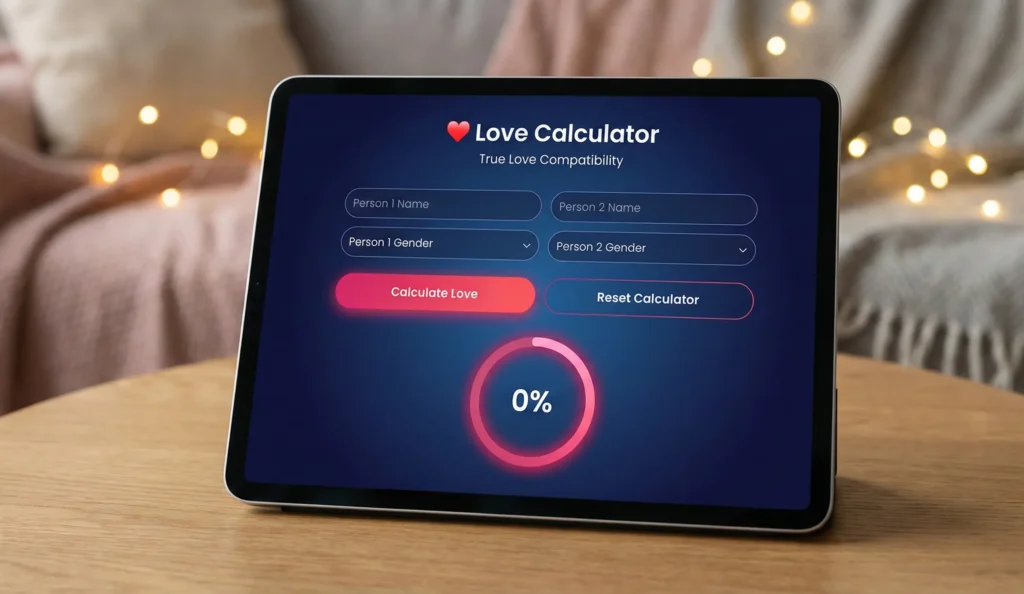
A love calculator name test is an online entertainment tool that compares two names and generates a numerical result, usually presented as a percentage. For example, someone might enter their own name alongside the name of their crush and receive a result of 82%. The calculator may describe this score as a promising match or a sign of romantic compatibility, depending on how its result messages are designed.
The actual process varies from one calculator to another. Some tools use simple mathematical operations on the letters in each name, while others apply predefined rules or playful algorithms to produce a percentage. Many are designed primarily to entertain users rather than provide meaningful relationship assessments. Since there is no universal calculation method, the same pair of names could receive different results from different tools.
The popularity of these tests comes from their simplicity. Users do not need to answer lengthy questions or provide detailed information about their relationships. Entering two names is usually enough to generate a result within seconds. This convenience makes name calculators attractive to people who want a quick, lighthearted experience without taking a formal personality test.
How Does a Love Calculator Name Work?
Although the results may appear mysterious, most name-based calculators rely on programmed rules rather than any hidden understanding of romance. A basic tool might assign numerical values to letters, count repeated characters, combine the letters in two names, or apply a mathematical formula. It then converts the resulting number into a percentage that appears to represent compatibility.
For instance, imagine that someone enters the names of two people and receives a result of 76%. The calculator might display a positive message suggesting that the pair has a good romantic connection. Another calculator could produce 64% for exactly the same names because it uses a different formula. Neither number establishes whether the two people genuinely like each other or would build a successful relationship.
The result is therefore best understood as a programmed output. It does not reveal private feelings, determine whether someone has a crush on you, or predict whether a relationship will last. Real romantic compatibility depends on a wide range of personal and social factors that cannot be accurately represented by the spelling of two names.
Common Methods Used for Name Matching
Different calculators may use different approaches to create their results. Some rely on letter patterns, while others use simple arithmetic or randomly generated entertainment scores. Numerology-inspired tools may also associate letters with numbers and interpret the resulting values symbolically. These methods can make the experience feel personalized, but their interpretations should not be confused with scientific evidence.
A calculator might also generate different descriptions for different percentage ranges. A high score could be labeled an excellent match, while a lower score might produce a message encouraging the users to learn more about each other. Such descriptions are generally part of the entertainment experience rather than conclusions based on verified relationship research.
Why Are Name-Based Love Tests So Popular?
One reason these tests attract attention is that romantic curiosity is a common human experience. When people develop feelings for someone, they often look for reassurance or small clues about whether the attraction might be mutual. A simple name test provides an immediate result without requiring a difficult conversation or a direct expression of feelings.
These calculators also fit naturally into digital conversations. Friends can compare their results, couples can test different name combinations, and people with crushes can share screenshots for fun. The activity is easy to understand, requires little effort, and can lead to humorous or affectionate discussions. On social media, short and visually appealing results can also encourage people to share their experiences with others.
Another reason for their popularity is the emotional meaning people attach to names. A person’s name may remind someone of a special meeting, a meaningful conversation, or an important stage in a relationship. Combining two names in a playful test can create a small personal moment, even when the calculation itself has no scientific value.
However, enjoyment should not become dependence. A positive result may make someone smile, but a negative result should not create unnecessary anxiety. The real value of the activity lies in the experience and conversation it creates, not in the number displayed on the screen.
How to Use a Love Calculator Name Tool
Using a name calculator is generally straightforward. Most tools follow a similar process, although their design and result formats may differ. You usually need only two names and a few seconds to see the outcome.
- Enter your first name or the name you commonly use.
- Type the name of your crush, partner, or the person you want to test.
- Select the calculate option to generate the result.
- Read the percentage and any accompanying message for entertainment.
- Share the result with the other person if you both feel comfortable doing so.
Some calculators allow users to enter full names, while others work with first names only. If the result changes when you use a nickname instead of a full name, that difference usually reflects the tool’s calculation method rather than a change in your actual compatibility.
It is also sensible to avoid entering unnecessary personal information. A basic entertainment test does not need your home address, phone number, passwords, or private conversations. If a tool requests information unrelated to calculating a name-based result, consider whether sharing that information is appropriate.
Understanding Love Compatibility Percentages
The percentage is often the most exciting part of the experience because it gives a simple number to something that is otherwise complicated. A result of 90% might feel encouraging, while a result of 35% might seem disappointing. Yet these numbers have no universal meaning because different calculators use different formulas and interpretations.
The following table explains how users can approach common score ranges without treating them as reliable predictions.
| Percentage range | Possible entertainment interpretation | What it actually tells you |
|---|---|---|
| 0–39% | A playful low-match result | The calculator generated a low score |
| 40–59% | A moderate or uncertain match | The result depends on the tool’s formula |
| 60–79% | A promising match | The number does not verify romantic compatibility |
| 80–100% | A supposedly strong connection | The score cannot guarantee a successful relationship |
These ranges are illustrative, not an official standard followed by every calculator. Some tools may use different categories or display only a percentage without an explanation.
A high score does not mean that two people share the same values, communicate well, or are ready for a relationship. Likewise, a low score does not mean that a couple is incompatible. Two people may have very different names and still develop a loving, respectful partnership through honesty, understanding, and shared effort.
Can a Love Calculator Name Predict Your Future?
A name-based test cannot reliably predict whether two people will fall in love, get married, remain together, or experience a lasting romantic connection. There is no established scientific basis for using the letters in two names to calculate the future of a relationship. Such tools are better treated as games than as methods of making important personal decisions.
Relationships develop through experiences, choices, emotions, and circumstances. Two people may initially feel strong attraction but later discover differences in their expectations or priorities. Another pair may begin as friends and gradually build a deep connection through trust and shared experiences. These outcomes depend on much more than names or a numerical score.
If you enjoy checking compatibility percentages, there is no need to stop simply because the result is not scientific. The important distinction is between having fun and believing that the result determines your future. You can appreciate a high score without assuming that a relationship is guaranteed, and you can laugh at a low score without doubting a genuine connection.
When serious relationship decisions arise, pay attention to how the other person treats you, whether communication feels comfortable, and whether your expectations align. These observations provide far more useful information than a number generated from two names.
Real Signs of Romantic Compatibility
Although online tests can be entertaining, genuine compatibility is better understood by observing how two people interact. Attraction can create an exciting beginning, but a healthy relationship usually requires consistent effort from both individuals. Emotional safety, mutual respect, honesty, and the ability to resolve disagreements all contribute to a stronger connection.
Communication is particularly important. Compatible partners do not necessarily agree about everything, but they can discuss differences without constantly insulting, threatening, or dismissing each other. They listen to understand rather than simply waiting for their turn to speak. They also recognize that each person may need time, privacy, friendships, and individual interests outside the relationship.
Shared values can matter as well. Two people may have different hobbies, educational backgrounds, or personalities while still agreeing on important matters such as honesty, family expectations, personal boundaries, and future goals. Understanding these differences early can help both individuals decide whether they want to build a relationship together.
Instead of relying entirely on a calculator, consider the following practical questions when evaluating a developing connection:
- Do both people show genuine interest and make time for each other?
- Can you express your thoughts and feelings without fear of ridicule?
- Do you respect each other’s boundaries, privacy, and independence?
- Can you discuss disagreements honestly and work toward solutions?
- Do your important values and relationship expectations align?
These questions are not a mathematical test either. They are starting points for reflection that can help you understand the quality of a relationship more clearly.
Fun Ways to Enjoy Name Compatibility Tests
Name calculators can become more enjoyable when they are treated as shared activities rather than serious evaluations. Couples might test their names together and compare the messages they receive. Someone with a crush might use the result as a playful conversation starter, provided the other person is comfortable with the joke. Friends can also compare scores simply to see how the calculator responds to different combinations.
You can make the experience more creative by comparing nicknames, trying different spellings, or discussing what makes each person feel appreciated. For example, if a calculator produces an unexpectedly low score for a happy couple, the difference can become a humorous reminder that software does not understand their shared experiences. Similarly, a high score can provide a reason to smile without being treated as proof of destiny.
The activity can also encourage conversations about romantic expectations. After viewing a result, partners might discuss what they value most in a relationship, how they prefer to communicate, or what makes them feel supported. These discussions can be more meaningful than the original calculation because they involve the people themselves rather than an automated formula.
The key is to keep the activity comfortable and respectful. Do not use a result to pressure someone into dating, question their loyalty, or suggest that they owe you romantic attention. A calculator should never replace consent, honest communication, or respect for another person’s feelings.
Common Misunderstandings About Name Compatibility
One common misunderstanding is that a high percentage confirms that two people are meant to be together. This belief may feel appealing when someone has strong feelings for another person, but a calculator cannot establish mutual attraction or predict long-term happiness. The result is simply an output produced by a particular method.
Another misunderstanding is that a low score means a relationship has little chance of succeeding. In reality, the score may change when names are shortened, spelling is altered, or a different calculator is used. These changes demonstrate that the percentage is tied to the tool’s rules rather than a reliable measurement of the relationship.
Some people also assume that every love calculator uses the same formula. In practice, calculators can vary considerably in their programming, presentation, and scoring systems. There is no single recognized standard that makes one result universally meaningful.
Finally, people sometimes confuse entertainment with evidence. A test may use confident language or display a precise percentage, but an exact-looking number does not automatically make a result accurate. Understanding this difference helps users enjoy these tools without allowing them to influence important decisions unnecessarily.
Conclusion
A love calculator name test offers a simple and entertaining way to explore romantic curiosity. By entering two names, users can receive a compatibility percentage, compare results, and enjoy a playful moment with a crush, partner, or friend. Its convenience and personal feel help explain why name-matching games continue to attract attention in the digital world. However, the result should always be understood in the right context. A percentage generated from two names cannot determine whether someone loves you, predict a relationship’s future, or measure the strength of an emotional bond. Different tools may produce different outcomes because their formulas and scoring methods are not standardized. The most meaningful relationships grow through mutual respect, honest communication, trust, shared values, and consistent effort. These qualities cannot be replaced by a calculator, regardless of how impressive its score appears. Enjoy the experience, laugh about surprising results, and use the activity as an opportunity to connect with others.