

.jpg&description=Explore how a love calculator name tool compares two names, calculates a fun compatibility score, and helps couples enjoy a playful experience together.)
Love has always been one of the most fascinating parts of human life. From the excitement of a first crush to the happiness of being in a relationship, people naturally look for ways to understand their feelings and discover whether someone special might be a good match. Names often become part of this curiosity because they carry personal meaning, memories, and emotional connections. This is why online name compatibility games have attracted attention among people who enjoy exploring romance in a fun and uncomplicated way.
A love calculator name tool is a playful way to compare two people’s names and generate a compatibility percentage. Users usually enter their own name and the name of someone they admire, after which the calculator produces a score that represents a fictional love match. Some tools also display romantic messages or short interpretations of the result. Although the experience can be entertaining, it is important to understand that the score is not a scientific measurement of attraction, emotional connection, or long-term relationship success.
In today’s digital environment, people frequently discover relationship games through social media conversations, messaging groups, and online entertainment. Name-based love calculators fit naturally into this trend because they are simple to use and easy to share with friends. Whether someone wants to explore a crush, create a lighthearted conversation, or enjoy a romantic activity with a partner, understanding how these calculators work can make the experience more enjoyable and meaningful.
What Is a Love Calculator Name Tool?
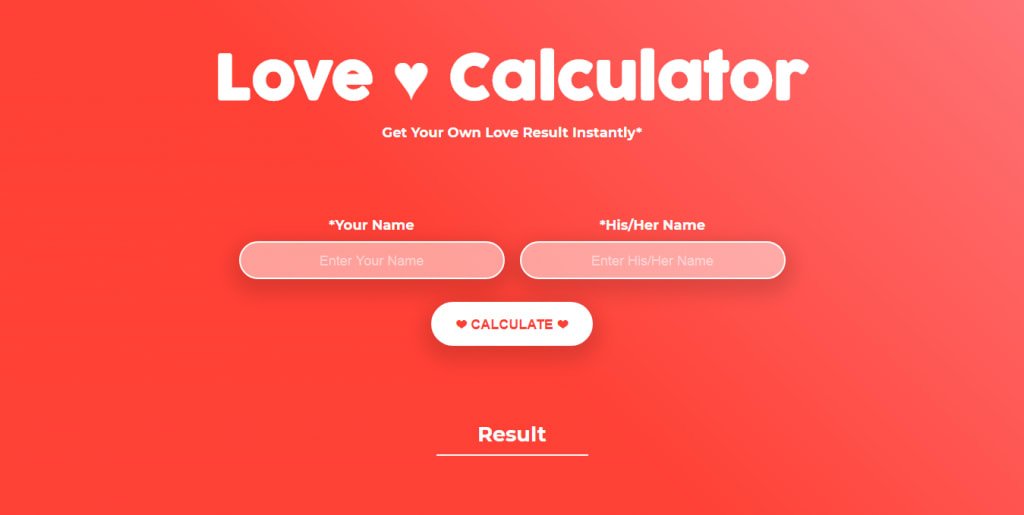
A love calculator name tool is an online entertainment feature designed to compare two names and produce a numerical compatibility result. The basic idea is straightforward: a person enters two names, selects a calculation option if available, and receives a percentage or a short description of the supposed romantic connection. For example, someone named Rahul might enter the name Priya and receive a result suggesting that the pair has an 82 percent compatibility score. The exact result depends on the method used by the particular calculator.
The appeal of these tools comes from their simplicity. Unlike detailed relationship questionnaires, which may ask about communication habits, personal values, and lifestyle preferences, a name calculator generally requires only a few seconds to use. It does not demand extensive personal information or a long assessment. This makes it suitable for casual entertainment, friendly challenges, and playful conversations between people who want to share a laugh or explore a romantic possibility.
However, a compatibility percentage should be understood as a game result rather than a prediction. Two names cannot reveal whether people respect each other, resolve disagreements effectively, or share similar expectations for the future. The calculator offers a fun starting point for conversation, but the actual quality of a relationship depends on much more than the letters in two names.
How Does a Love Calculator Name Work?
Different calculators use different methods to produce their results. Some rely on simple mathematical operations involving the letters in two names, while others use predefined rules, character combinations, or randomly generated percentages. Certain tools may convert letters into numbers, combine the values, and apply a formula to produce a score. Other versions simply generate an entertaining result without a meaningful mathematical relationship between the names.
For example, imagine entering the names Aman and Neha. A basic calculator might assign numerical values to the letters, add them together, and use the final number to determine a compatibility percentage. Another calculator might use the number of letters in each name or apply a fixed scoring pattern. Because there is no universal formula, the same pair of names can receive different scores on different platforms.
The result is therefore determined by the calculator’s design, not by a verified assessment of romantic compatibility. A high score does not prove that two people are destined to be together, and a low score does not indicate that a relationship will fail. Understanding this distinction allows users to enjoy the activity without treating a numerical result as serious relationship advice.
How to Use a Name-Based Love Calculator
Using a love calculator is generally a simple process. Most versions follow a similar pattern, although the exact layout and available features can vary. Users enter two names, activate the calculation feature, and read the resulting percentage or message. Some calculators may include additional options, such as selecting a relationship category or viewing a short explanation of the result.
A typical experience involves the following steps:
- Enter your first name or the name you want to use.
- Enter the name of your crush, partner, or chosen person.
- Select the calculation option to generate a result.
- Read the compatibility percentage and enjoy the result as entertainment.
For example, if someone enters the names Arjun and Meera, the calculator might display a result of 76 percent. The number can become a conversation starter, especially if both people understand that the activity is playful. Friends may compare results, couples may use it for a lighthearted challenge, and individuals may enjoy exploring different combinations simply out of curiosity.
The important point is to keep expectations realistic. The calculator does not need to produce a high score to make the experience enjoyable. Its main purpose is to provide a brief moment of entertainment rather than determine what someone should feel or whom they should date.
Understanding Love Compatibility Percentages
Love compatibility percentages are often the most noticeable feature of a name calculator. A result of 95 percent may appear more exciting than a result of 45 percent, but these numbers do not have an established psychological meaning when they are generated from names alone. Their interpretation depends entirely on the tool’s formula and presentation.
The following table explains how users might interpret common score ranges in a playful context. These descriptions are examples for entertainment, not scientifically validated relationship categories.
| Compatibility score | Playful interpretation | What it actually means |
|---|---|---|
| 90–100% | A supposedly perfect match | A high result generated by the tool |
| 70–89% | A promising romantic pairing | An entertaining compatibility score |
| 50–69% | A balanced or curious match | A numerical result without proven significance |
| 30–49% | An unexpected pairing | A low-to-moderate score produced by the formula |
| 0–29% | A surprising result | No reliable prediction about the relationship |
It is helpful to remember that the percentages are not probabilities. A score of 90 percent does not mean there is a 90 percent chance of falling in love, getting married, or maintaining a successful relationship. Likewise, a result of 20 percent does not mean that two people have little chance of developing a meaningful connection. The figures are simply part of the entertainment experience.
Why Are Name Love Calculators Popular?
One reason for the popularity of name calculators is that they connect with a universal human interest: curiosity about relationships. When someone develops a crush, even small details can become interesting. A person’s name, favorite song, or shared interests may remind someone of the possibility of a romantic connection. A calculator turns this curiosity into a quick activity that feels personal without requiring a serious commitment.
Another reason is the ease of sharing results. People often enjoy comparing scores with friends or discussing whether a result seems accurate. In group conversations, a calculator can introduce humor and friendly competition. Couples may also use it as a playful activity during a casual conversation, particularly when they want to add something different to their routine.
Digital entertainment has also made simple interactive experiences more accessible. Many users prefer activities that deliver an immediate result without complicated instructions. A name calculator meets that expectation by offering a short, easy-to-understand experience. Its appeal does not depend on scientific accuracy; instead, it comes from curiosity, surprise, and the social enjoyment of discussing the outcome.
Can Names Really Predict Romantic Compatibility?
Names alone cannot reliably predict whether two people will develop a successful romantic relationship. A name can have cultural, personal, and emotional significance, but its letters do not provide enough information to determine personality, shared values, emotional maturity, or relationship expectations. These factors are far more relevant when people are trying to understand whether they are compatible.
Real compatibility develops through everyday interactions. Two people may feel attracted to each other initially, but a healthy relationship also requires honesty, respect, trust, and the ability to communicate openly. For instance, a couple may have different hobbies but still build a strong relationship because they support each other’s interests and discuss disagreements constructively. Another couple may share similar interests but struggle if they cannot communicate or respect personal boundaries.
This is why a name-based calculator should not be used to make important romantic decisions. A low percentage is not a reason to reject someone, and a high percentage is not a guarantee that a relationship will work. The most useful approach is to treat the score as a game and judge real compatibility through mutual understanding, consistent behavior, and shared expectations.
Fun Ways to Enjoy a Love Calculator
A name calculator can become more entertaining when it is treated as a social activity rather than a serious test. Friends can compare results for fictional couples, celebrities, or characters from popular films and television shows. These comparisons can lead to funny discussions about which pairs seem most compatible and why. Since the results are not factual predictions, there is plenty of room for imagination and humor.
Couples can also use the activity as an icebreaker. They might enter their names, compare the result with their own experiences, and talk about what makes their relationship special. A surprisingly high score may become an amusing memory, while a low score can inspire a joke about how the calculator needs a better formula. The experience works best when both people feel comfortable and understand that the result has no authority over their relationship.
For a more meaningful conversation, users can follow the game with questions about real compatibility. They might discuss favorite shared memories, personal goals, communication preferences, or qualities they appreciate in each other. This approach combines the lighthearted nature of the calculator with an opportunity to understand another person more deeply.
Privacy and Safety When Using Online Calculators
Although many name calculators require very little information, users should still pay attention to privacy. A basic calculator may need only two names, while some websites may request additional details, such as birth dates, email addresses, or other personal information. These extra details are not necessary to establish whether two people are romantically compatible.
Before entering information, users should consider whether the requested details are appropriate for a simple entertainment activity. It is generally better to avoid providing phone numbers, home addresses, passwords, financial details, or other sensitive information. People should also be cautious if a calculator asks them to download an unfamiliar application, complete suspicious surveys, or provide unnecessary personal data to reveal a score.
Another important consideration is consent. Entering a person’s name for a harmless private game is different from publishing their information or sharing a result in a way that embarrasses them. Respecting privacy and personal boundaries helps ensure that the activity remains enjoyable. Young users, in particular, should understand that online scores are generated by software and should never feel pressured to share private information because of a romantic game.
Alternatives to Name-Based Compatibility Scores
People who want a deeper understanding of romantic compatibility can explore approaches that focus on real behavior rather than names. Meaningful conversations about values, expectations, and communication often reveal more about a potential relationship than any percentage. These discussions do not need to feel like formal interviews; they can develop naturally as two people spend time together.
For example, discussing future goals can help people understand whether their expectations are reasonably aligned. Talking about how they handle stress can reveal whether they are comfortable supporting each other during difficult moments. Observing how someone treats friends, family members, and strangers can also provide useful insight into their character. These observations are more informative than a score produced by a name-based formula.
Relationship questionnaires may offer another way to reflect on communication styles and preferences, provided they are used thoughtfully. However, even detailed questionnaires have limitations and should not replace honest discussion or professional support when serious relationship concerns arise. The goal is not to discover a perfect numerical match but to understand whether both people can build a respectful, supportive, and mutually satisfying connection.
The Future of Online Love Calculator Tools
Online entertainment continues to evolve as developers experiment with interactive designs, personalized results, and artificial intelligence. Future name calculators may include more engaging animations, customizable messages, relationship-themed quizzes, or options for comparing different fictional and real-life pairings. These features can make a simple activity feel more personal and enjoyable without changing the basic nature of the experience.
Some tools may also combine names with additional questions about interests or preferences. While this could create a more detailed entertainment experience, the reliability of any result would depend on the information collected and the method used to interpret it. A sophisticated interface does not automatically make a calculator scientifically valid. Users should distinguish between a tool that is engaging and one that has evidence supporting its claims.
As online privacy becomes increasingly important, responsible design should also prioritize transparency and data minimization. A useful entertainment tool should explain what information it collects, avoid requesting unnecessary details, and make its limitations clear. These practices can help people enjoy interactive relationship games without confusing entertainment with factual predictions.
Conclusion
A love calculator name tool offers a simple and entertaining way to explore romantic curiosity. By entering two names and receiving a compatibility percentage, users can enjoy a quick activity that may inspire laughter, friendly competition, or an interesting conversation. Its popularity comes from its simplicity and the universal appeal of wondering whether two people might make a good match. Nevertheless, the results should always be viewed as entertainment rather than a reliable prediction of love. Names cannot establish emotional compatibility, determine future relationship success, or reveal whether two people are right for each other. Trust, communication, respect, shared expectations, and consistent effort play much more important roles in building a healthy connection. Ultimately, the best way to enjoy a love calculator is to appreciate the fun without allowing a percentage to influence important decisions. A high score can be a reason to smile, and a low score can become a joke, but neither defines the value of a relationship. Real connections are built through understanding, kindness, honesty, and the choices people make together over time.